
The cleanest way to evaluate the New Balance 2002R “Protection Pack – Phantom” listing is to match three things before checkout: the catalog identity, the photo evidence, and the size evidence. The fixed identifier is M2002RDB. “2002R,” “Protection Pack,” and “Phantom” are useful labels, but none is as precise on its own.
This is not an authenticity test. A gallery, style code, or product description cannot establish that UA reps are authentic retail merchandise. The practical goal is narrower: make sure every answer, image, measurement, and selected option refers to the same M2002RDB listing and does not conflict with another part of the record.
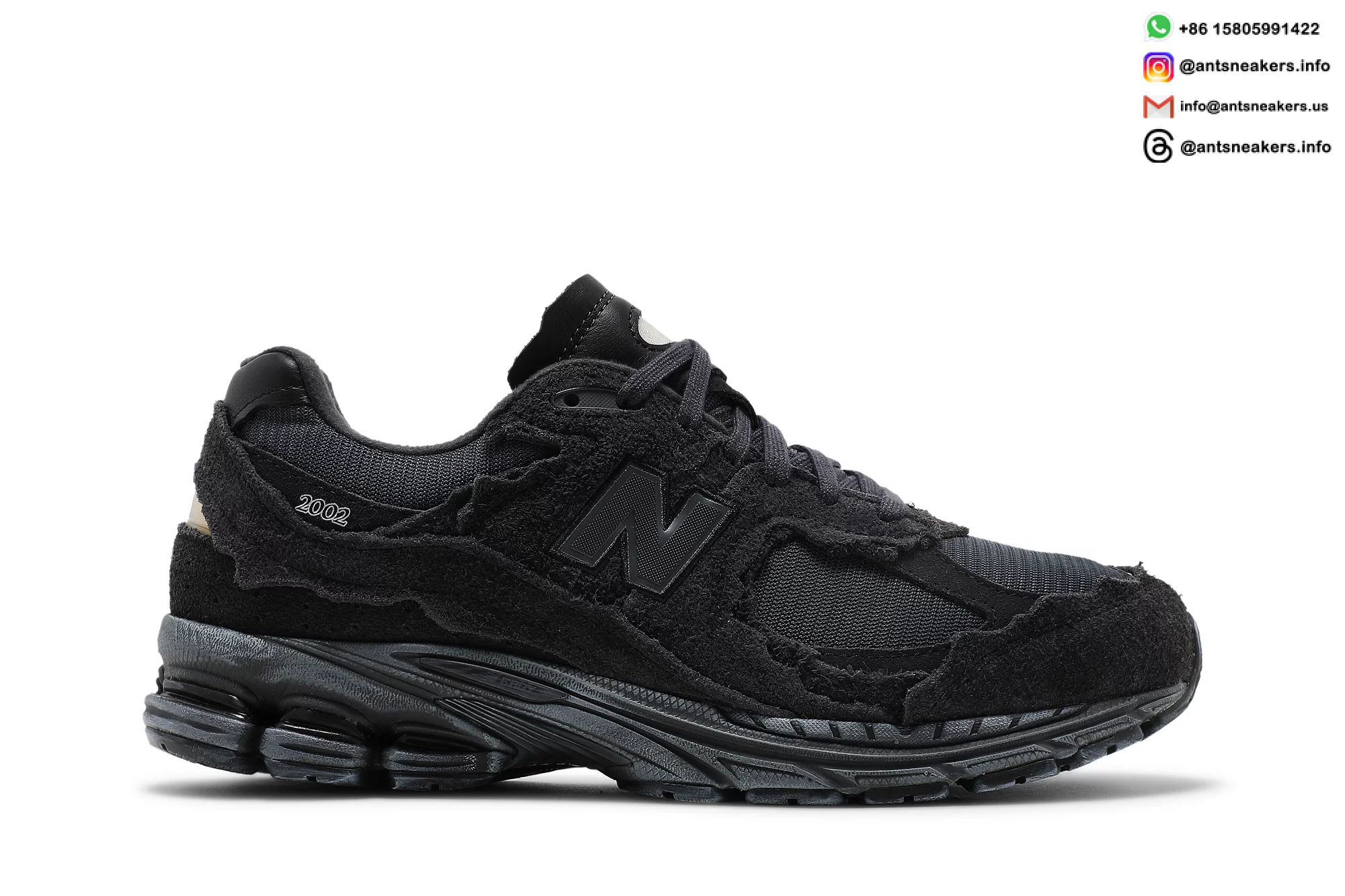
Reduce the listing to an identity card
Save the product-page fields below in one note. They are statements on the listing, not independently verified specifications. Keeping them together makes contradictions easier to spot when you request more information.
| Listing field | Recorded value | What it controls |
|---|---|---|
| Style code | M2002RDB | The code to match on the selected option, label photo, and order confirmation. |
| Product name | New Balance 2002R “Protection Pack – Phantom” | The model and colorway context for the request. |
| Listed colorway | Phantom/Magnet | The page’s color label; lighting can still change how the tones appear in photos. |
| Listed main color | Black | A catalog field, not a substitute for seeing the actual dark-grey tonal range. |
| Listed upper material | Suede | A prompt for close photos; it is not an independent material test. |
| Listed release date | 08-14-2021 | A reference field that should not be confused with manufacture or shipment timing. |
The page description also refers to a mesh base, raw-edged suede overlays, a tonal “N,” a lateral 2002r callout, and a distressed-looking midsole. Those phrases are most useful as a map for requesting photos. They do not prove construction, comfort, or retail equivalence.
Use “Protection Pack” as context, not the final identifier
The listing describes the Protection Pack as a group of neutral colorways. That makes the pack name too broad for an order record. “Phantom” narrows it, but the code M2002RDB should still appear wherever the chosen pair is identified. If a message, label, or confirmation shows a different code, resolve that conflict before treating the evidence as relevant.
Neutral tones create a second problem: one photo can look black, charcoal, or brown-grey depending on exposure and white balance. Do not demand that every image reproduce the catalog color exactly. Ask instead for consistent lighting and a neutral object in frame, then compare panel relationships within the same image set.
Turn the gallery into five inspection zones
A gallery is easier to use when each visible area has a specific question attached. Work from large relationships to small details; isolated close-ups are difficult to interpret without a full-shoe view.
| Zone | Catalog cue from the listing | Current evidence to request |
|---|---|---|
| Whole side profile | Dark tonal upper with layered, irregular-edged panels | Both outer sides in one level frame, followed by both inner sides from the same distance. |
| Upper boundaries | Mesh base and raw-edged overlay treatment | Unfiltered close views showing the transitions around the toe, eyestay, and collar. |
| Quarter panel | Tonal “N” and a 2002r callout on the lateral side | A straight side view where placement and stitching are readable on each shoe. |
| Midsole and outsole | Distressed visual treatment on the midsole | Level side and bottom views; ask whether marks in question are intentional finish or visible damage. |
| Identity labels | M2002RDB and the selected size | Readable labels for both shoes in the same request, without cropped code or size fields. |
Seeing the same feature on both shoes matters more than receiving many unrelated detail shots. A seller-supplied current photo should also be kept separate from the catalog gallery in your notes. Labeling each source prevents a catalog image from being mistaken for evidence of the pair under consideration.
Request one controlled photo rotation
Ask for a short sequence taken on a flat surface: front, outer sides, rear, inner sides, top, and outsoles. Keep both shoes in frame for the front and rear views. The camera height and distance should stay roughly constant while the pair rotates. This makes obvious left-to-right differences easier to see without pretending that perspective can be eliminated.
If one panel, edge, or seam is unclear, request a focused follow-up of that location on both shoes. A single close-up cannot show whether the other shoe matches, and a compressed image cannot support a confident judgment about texture. Ask for a second angle instead of converting uncertainty into a quality score.
Useful questions are concrete: Is this the M2002RDB pair attached to the selected size? Are these photos current? Can both size labels be shown clearly? Can the same area be photographed without a filter? General assurances such as “best quality” or “looks perfect” do not answer those questions.
Define the size evidence before asking for a number
A size label and a physical measurement answer different questions. The label records the option. The measurement helps compare the available pair with a shoe that already fits you. Neither guarantees comfort, and neither justifies a universal “true to size” statement for UA reps.
- Choose a reference sneaker worn with the socks you expect to use.
- Record its full size label and whether it feels snug, neutral, or roomy.
- If its insole is safely removable, measure usable length from the same endpoints you will request for M2002RDB.
- Request the selected pair’s measurement with the ruler and both endpoints visible.
- Confirm whether the reported number is an insole, internal, or outsole measurement; do not compare different methods as if they were equivalent.
- Base the decision on the larger foot and the toe room you personally prefer.
If an insole cannot be removed without damage, ask for an internal measurement and document the method. Do not silently substitute outsole length. Upper volume, padding, lacing, foot shape, and personal preference remain variables even when two length measurements agree.
Create a checkout packet with no orphaned evidence
Before payment, put the decision inputs into a single message or note. Every image and number should be attached to a named field rather than saved as an unexplained screenshot.
- Product: New Balance 2002R Protection Pack – Phantom.
- Style code: M2002RDB.
- Selected option: copy the complete size wording shown at checkout.
- Photo source: mark catalog references and current-pair photos separately.
- Measurement: record the value, unit, method, and visible endpoints.
- Open questions: list any code, size, color, panel, or condition conflict that still needs a direct answer.
Review the seller’s current terms for the chosen item and region rather than assuming a delivery time, exchange right, or guarantee. If the selected size, label photo, measurement, and order confirmation do not point to one coherent pair, the record is not ready simply because the catalog page looks complete.
Use a conflict rule instead of a quality ranking
Proceed to a personal buying decision only when the evidence agrees on identity and the remaining uncertainty is acceptable to you. Ask for clarification when a photo source or measurement method is unclear. Pause when the code differs, the selected option cannot be tied to the shown labels, left and right shoe evidence comes from incompatible sets, or a visible concern is answered only with a general promise.
This rule does not declare the pair “good,” “best,” or authentic. It prevents a more basic failure: making a decision from evidence that belongs to different products, sizes, or photo sets.
Repeat the identity match after arrival
Before outdoor wear, and while following any stated seller terms, compare the received item with the saved checkout packet. Check the code and size labels first. Then recreate the full-pair views and the measurement using the same method. Document any clear mismatch, open seam, loose edge, transit mark, or left-to-right difference with both an overview and a close view.
The final value of the record is continuity. The M2002RDB listing, chosen option, current evidence, checkout confirmation, and received pair should all describe the same item. When they do not, name the exact conflicting field instead of relying on memory or a broad claim about quality.
Disclosure: this article discusses a UA-reps listing. UA reps should not be represented as authentic retail merchandise. No customer review, testimonial, ranking, delivery promise, retail-equivalence claim, product guarantee, or authenticity conclusion is made.